
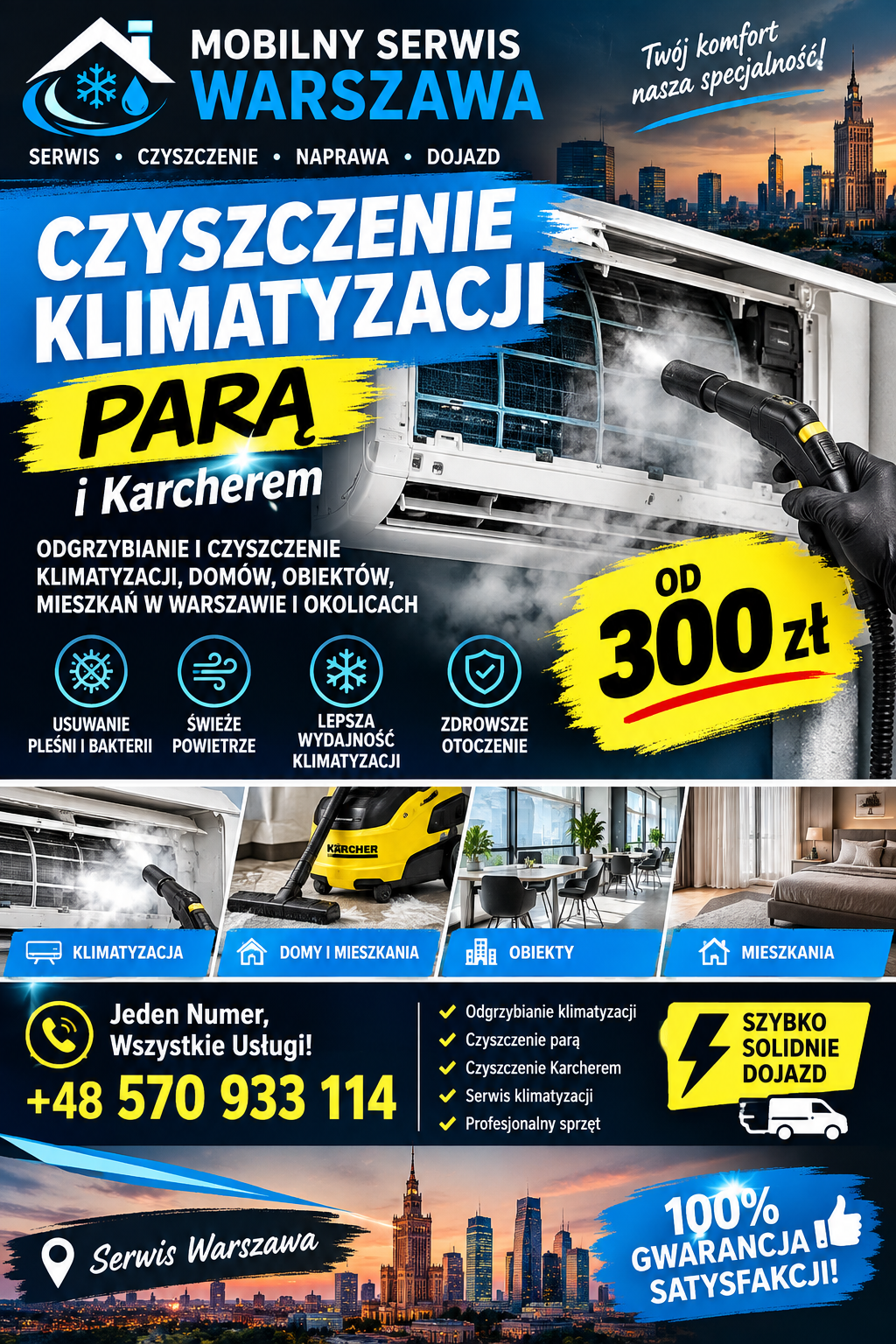
Steam Air Conditioning Cleaning - Steam and Kercher Cleaning Service in Warsaw - Mold Removal and Cleaning of Air Conditioning, Houses, Buildings, Apartments in Warsaw and the surrounding area, order the cheapest and best service for your house or apartment.
One Number, All Services!
+48 570 933 114
Mold Removal and Steam Cleaning, Karcher, Home Air Conditioning Service, etc. Mobile Service Warsaw
100% Satisfaction Guarantee!
Warsaw service
Steam Attacks Dirt Like a Superhero! Cleaning with Delivery in the Capital and Surrounding Areas!
Steam cleaning of air conditioning at home - Mobile Service Warsaw
Konrad Wiśniewski | Tel. 570 933 114
My name is Konrad Wiśniewski, and for years I've been running several service companies operating in Warsaw and the Masovia region. One of them is Mobile Service Warsaw, which specializes in, among other things, steam cleaning and de-mold air conditioning systems directly in the customer's home. I'm writing this article a bit differently than the usual service descriptions on websites – without marketing fluff, but rather a detailed look at what it looks like in practice, what happens inside an air conditioner, the differences between different types and brands, how much it costs, and when it's even worth considering.
I've been driving around Warsaw and the surrounding area for a while now, and I've seen just about everything – air conditioners that haven't been cleaned since they were installed eight years ago, units clogged with cat hair so much that the fan barely rotated, and units where someone tried to do something quickly themselves and ended up with a flooded wall. So I decided to describe it properly, so anyone who stumbles upon this page knows exactly what they're dealing with and what to expect when I come to visit.
Why do you need to clean your air conditioning at all?
An air conditioner, regardless of brand or type, does one basic thing: it passes room air through a heat exchanger (evaporator), which cools it. During this process, moisture from the air condenses on the surface of the heat exchanger—a simple physical phenomenon, just like steam condensing on a glass of cold drink on a warm day. The problem begins when this moisture is combined with dust, pollen, pet dander, cigarette smoke, or ordinary street dust, which passes through the filters. This mixture in the dark, damp, and warm interior of the unit creates precisely the conditions needed for fungi, mold, and bacteria to thrive.
After several months of use—sometimes sooner if the apartment has a pet or is located near a busy street—a thin, slippery organic layer, commonly known as biofilm, forms on the heat exchanger. This film is responsible for the characteristic, musty smell you experience immediately after turning on the air conditioning, especially if it has been sitting unused for some time, for example, in winter. Biofilm isn't just a matter of odor; it also reduces cooling efficiency, as clogged heat exchanger fins impair heat transfer, which in turn means the unit has to work longer and harder to achieve the same room temperature. In practice, this translates into higher electricity bills.
The second critical element is the condensate tray and the pipe that drains the water to the outside. Since moisture condenses on the evaporator, it has to go somewhere – and it's precisely there, in stagnant water, warmth, and darkness, that bacteria thrive, including those that can be truly hazardous to your health if dispersed in the air for extended periods. If the drain becomes clogged (and it does so from the very same sediment I mentioned above), water begins to back up, overflows the tray, and most often ends up with a stain on the wall beneath the indoor unit. This is one of the most common situations I hear from customers about – and in the vast majority of cases, it could have been avoided if someone had taken care of regular cleaning.
The third element is the fan, the elongated, grooved shaft located just behind the evaporator. Its task is to draw air through the filter and heat exchanger, and then blow the cooled air back into the room. When it becomes contaminated with deposits from the evaporator, each time the air conditioning is turned on, it also ejects some of this deposit along with the air we breathe. This is particularly noticeable to people with allergies or asthma – suddenly, even though there are no flowers outside, a scratchy throat begins, watery eyes begin, or a runny nose returns, and this happens precisely when the air conditioning is on.
The steam method – why do I choose it?
There are plenty of DIY air conditioning "de-fungus" sprays available online – you spray them through the drain hole or directly onto the heat exchanger after removing the front cover. They do some good, but not much, as these products mainly act on the surface. The real problem, the biofilm layer sandwiched between the heat exchanger fins and the deposits on the fan blades, mostly stays in place.
Steam works differently. For me, it's a temperature of around 150–180°C at the nozzle outlet, delivered at the appropriate pressure. This steam literally penetrates the fins of the evaporator—where no brush can reach—and mechanically flushes out whatever's there, while also being hot enough to destroy most of the microorganisms we're dealing with. After the treatment, there's no chemical odor left behind, because it's essentially just water in the form of steam. It evaporates, and there's no need to air out the area for half a day, as is the case with some aggressive chemicals.
In practice, the best results are achieved by combining two steps: first, I apply a biocidal agent in foam form, which dissolves biofilm and organic contaminants, and only then I apply steam, which mechanically rinses everything away and additionally sterilizes the surface. I do this in two steps because steam alone, without pre-dissolving it with chemicals, sometimes doesn't cope with very dirty units (and I encounter quite a few of those), and chemicals alone, without subsequent steam rinsing, leave residue on the heat exchanger, which is also not ideal.
What does my website look like step by step?
I arrive at your location with all the equipment you need – a steam generator, cleaning products, a service sleeve, and disassembly tools. No prior preparation is required, other than moving furniture if the unit is hanging over a couch or shelf.
Once on site, I first protect the wall and floor beneath the air conditioner. I install a special, waterproof service sleeve that covers the entire indoor unit and drains dirty water directly into the tank, preventing any drips onto the carpet, floorboards, or windowsill. I remove the front cover, remove the filters, and wash them separately in water and a mild detergent.
Then I apply a mildew-repellent cleaner directly to the heat exchanger and fan turbine, leave it for a few minutes to dissolve the dirt, and then rinse everything with pressurized steam – and this really makes a difference, as the water draining into the sleeve is often noticeably dark, even if the unit doesn't look very dirty. Additionally, I always check and flush the condensate drain, even if the customer hasn't asked for it, as this is the part responsible for most of the wall flooding I mentioned earlier.
If you have access to an outdoor unit (what people call the "generator" on a balcony or facade), I always suggest washing it too. It collects dust, leaves, and sometimes poplar pollen or insects, and a clogged condenser forces the entire system to work harder, which directly translates into higher electricity consumption in the summer. This is an element you need to be careful with – too strong a water jet can bend the delicate aluminum fins, so I do it by hand, with a controlled pressure, rather than with a pressure washer set to maximum.
Finally, I reassemble the unit, turn on the air conditioning, and check that it's cooling as it should—I measure the airflow temperature, check for leaks, and check that the unit is running quietly. A typical wall-mounted unit typically takes me 45 minutes to an hour and a half to service, depending on how dirty it was.
For people who want to additionally disinfect the entire room – for example, after an illness at home, or if there is a persistent strong odor in the apartment that cleaning the air conditioner alone won't completely eliminate, because the source is also in the carpets or curtains – I offer optional ozonation after the air conditioning service is completed.
Types of air conditioners I work with
Not every air conditioner in your home looks the same, so it's worth briefly explaining how they differ and how this affects the service itself.
The wall-mounted split unit is by far the most popular type in apartments and single-family homes in Warsaw. The white, elongated indoor unit hangs high on the wall and is connected to the outdoor unit by a refrigerant line. This is the unit I work with most often – access to the heat exchanger and fan is relatively easy after removing the front cover.
Multi-split – one outdoor unit serving multiple indoor units, often in different rooms. I see this primarily in larger apartments and houses where the client wanted to air-condition several rooms without installing a separate unit for each. I clean each indoor unit separately, just like a regular split system, but I need to make sure that each unit is working properly independently of the others after servicing.
Cassette (ceiling) air conditioning – installed in a suspended ceiling, with a round or square air intake grille visible from the room. I often encounter them in offices, homes with more modern interiors, or in rooms where a standard wall unit isn't aesthetically pleasing. Access to the heat exchanger is more difficult because it requires partial removal of ceiling panels, so such servicing takes longer.
Ducted air conditioning – a unit completely concealed in the suspended ceiling, with air distributed through a system of ducts and air vents to various parts of the apartment or house. This is the most advanced and most difficult system to maintain – in addition to the unit itself, you also need to ensure the ventilation ducts are clean, as this is where dust settles and mold can grow. I see it primarily in larger, newly built single-family homes in Wilanów, Konstancin, and the premium areas around Piaseczno.
Floor-ceiling air conditioning – less common in homes, more common in commercial premises or larger living rooms, mounted low on the floor or high on the ceiling, depending on the room layout.
Portable air conditioning – a freestanding unit on wheels with a hose leading out the window. It doesn't require professional installation, but it also gets just as dirty as a wall-mounted unit, and people tend to forget about it the most. I also service these units, although the design varies depending on the model, so sometimes you have to be more careful when disassembling them.
Brands I deal with every day
Over the years, I have serviced virtually all popular brands available on the Polish market, so I will briefly discuss the differences, because they actually matter for the cleaning itself.
LG and Samsung are definitely the most common brands in Warsaw apartments – the relatively simple design of the indoor unit, easy access to the filters and exchanger, and service is quick and without surprises.
Daikin and Mitsubishi Electric are higher-end models, often chosen for newer developments and single-family homes – the build quality is better, but some models have a more complex housing mounting system, so disassembly takes a bit longer. They're worth mentioning separately, as this group also includes Mitsubishi Heavy Industries , a separate line from the same manufacturer, with a slightly different internal design than the classic Mitsubishi Electric.
Gree , Haier , Midea and Kaisai are brands that have gained a lot of popularity in recent years due to their affordable price – I see them very often in newer installations, especially in Białołęka, Targówek and towns near Warsaw, where customers were looking for a good price-quality ratio.
Panasonic , Fujitsu , Toshiba and Hisense are brands that I come across less frequently, but also regularly – each of them has its own specifics when it comes to the method of disassembling the front cover, but the steam cleaning process itself is practically the same regardless of the manufacturer.
Electrolux and Carrier appear mainly in older installations, dating back a dozen or so years – there you sometimes have to be more careful, as the plastic housing elements become more brittle over time.
Regardless of the brand, the process is essentially the same: disassembly, initial vacuuming, chemical cleaning, steam cleaning, drain inspection, reassembly, and testing. The main differences lie in the time it takes to access the unit's interior.
Where do I go – all districts of Warsaw
I drive all over Warsaw, without exception, and to the surrounding towns. For clarity's sake, I'll list all the districts so no one has to wonder if I'll be able to get to their location:
Śródmieście – both older tenement houses with re-installed air conditioning, as well as new apartment buildings in the area of Grzybowski Square, Powiśle and the area around Rondo ONZ.
Mokotów – one of the districts where I work most often, from Stary Mokotów through Sadyba, Służewiec, to Wierzbno and the area around Puławska Street.
Ochota – both Stara Ochota and Szczęśliwice and the area around Ochota Politechnika.
Wola – from Muranów through Koło, Ulrychów, to the modern investments at Rondo Daszyńskiego.
Żoliborz – Old Żoliborz, Sady Żoliborskie, around Wilson Square.
Bielany – Chomiczówka, Wawrzyszew, Młociny, the area around the Bielany Forest.
Bemowo – Chrzanów, Górce, around Fort Bema.
Ursus – Niedźwiadek, Skorosze, area of the former Ursus Plant.
Włochy – Okęcie, Old Włochy, Raków.
Ursynów – Kabaty, Natolin, Stokłosy, Imielin, one of the greener districts where I regularly service houses near the Kabaty Forest.
Wilanów – both Old Wilanów and the newer estates of Miasteczko Wilanów, where I mainly come across large single-family houses with extensive canal systems.
Praga Południe – Saska Kępa, Grochów, Gocław, Kamionek.
Praga Północ – Nowa Praga, Szmulowizna, Ząbkowska area.
Targówek – Bródno, Zacisze, Elsnerów.
Rembertów – both old housing estates and newer single-family houses on the border with Wesoła.
Wawer – Anin, Międzylesie, Falenica, Radość – a district with a large number of single-family houses, where air conditioning is practically standard.
Wesoła – Stara Miłosna and the surrounding area, similarly many single-family houses.
Białołęka – Tarchomin, Nowodwory, Choszczówka – one of the fastest growing districts in terms of new housing investments, so also one of those where I have the most new installations to clean.
In addition to Warsaw itself, I also regularly travel to towns near Warsaw – Legionowo, Jabłonna, Łomianki, Marki, Ząbki, Zielonka, Nieporęt, and, from the south, to Piaseczno, Konstancin-Jeziorna, Góra Kalwaria, and Pruszków. If you don't see your town on this list, just give me a call – we can usually arrange a ride even a little further, if the dates work out.
How much does it cost and what does the price depend on?
The price depends primarily on how many units need to be serviced in a single visit and their condition. A single wall-mounted split system, cleaned regularly, is different from one that has been sitting unserviced for several years and is heavily clogged. A multi-split system with several indoor units is cheaper per unit than a single air conditioner, because travel and set-up time only counts once. Cassette or ducted air conditioning is more expensive to service than a standard split system, because access to the interior requires more work to remove the ceiling panels.
Before I begin any job, I always provide a specific price – usually during a phone call, based on the number and type of units. Final confirmation is made after viewing the unit on-site, should the condition be significantly different than described. I don't like surprises at the end, and I assume my clients don't either.
When is it really worth doing?
You don't have to wait until your air conditioning starts to smell. Here are a few signs that might make it worth making an appointment:
- there is a damp or musty smell coming from the air vent, especially right after turning it on after a long break
- the air conditioning cools noticeably less than before, despite the same settings
- the device has started to work louder than before or vibrations can be heard
- water droplets appear under the indoor unit or a stain is visible on the wall
- someone in the house has allergies or asthma and the symptoms get worse when the air conditioning is turned on
- the air conditioning has not been cleaned for over a year, even if everything seems to be working normally
At a minimum, I recommend a full service once a year, preferably before the summer season, before the unit begins its most intense use. It's worth cleaning the filters yourself more frequently – every 2–4 weeks during the season – it's the only thing you can do yourself without disassembling the entire unit and risking damage.
What I Don't Do at Home and Why It's Worth Leaving to a Professional
I understand that some people try to clean their air conditioning systems themselves – washing the filters under running water is perfectly sensible and safe, and anyone can do it. The problem begins when someone tries to access the heat exchanger or fan themselves, as there are two easy mistakes to make: either using too much water and flooding the electronics inside the unit, or using a chemical unsuitable for air conditioning, which will leave residue that irritates the respiratory tract instead of cleaning it. There's also the issue of properly securing the walls and floors – without a service sleeve, water and chemicals usually end up where they shouldn't.
Summary
I've been doing this for a long time, and I know that for most people, air conditioning is a device they only remember when it starts to bother them – with smell, noise, or poor cooling. If your home is similar, or you'd simply prefer to have it done properly once a year instead of struggling with a spray from the supermarket every season – give me a call, we'll schedule a date, and I'll come in person or with a team, depending on the scope of the work.
📞 570 933 114 – Konrad Wiśniewski, Mobile Service Warsaw, air conditioning steam cleaning with home delivery throughout Warsaw and the surrounding area